Placements
Where a file actually is: the drill-down from a tenant to a collection, a version, a file, its blocks, and every copy of every block — site, node and medium, down to the tape cartridge.
The drill-down
Each level is one paged verb call; the census on the last level comes from the leader's status:
- Tenant — the tenants a dashboard profile is bound in.
- Collection — the tenant's collections with their copy counts (
core.collections; the profiles' named collections as the fallback). - Version — the collection's versions: number, branch, who committed it, when, its files and logical bytes.
- File — the version's files with size and block count (
core.list, 100 per page). - Blocks — the file's blocks, 100 per page (
core.placement vid=… path=…, paged).
The file page
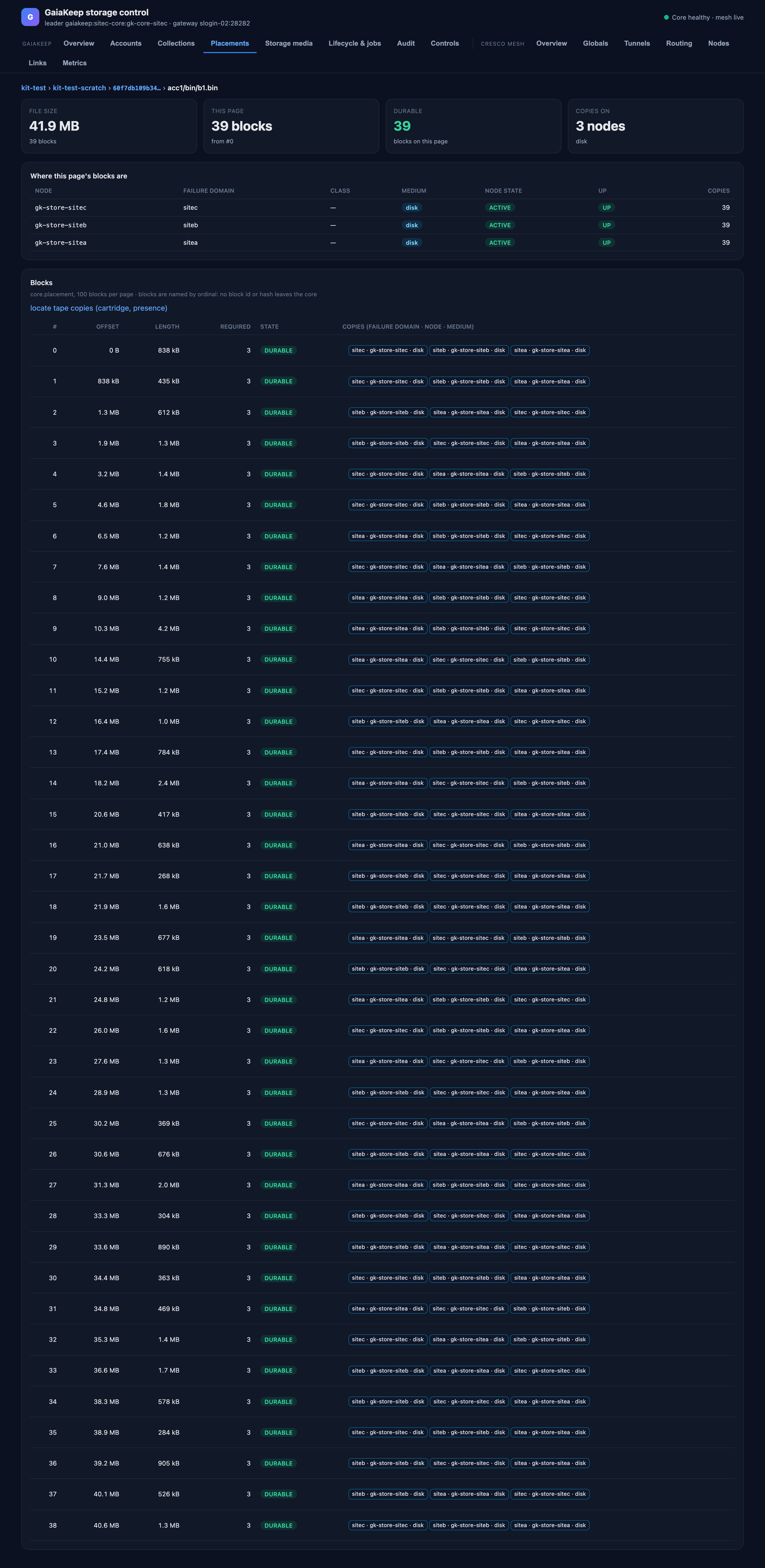
The tiles answer the four questions that matter: how big the file is, how many blocks it is cut into, how many of
those blocks on this page are DURABLE, and how many distinct nodes hold copies. "Where this page's blocks are"
groups the page's copies by node: failure domain, class, medium, node state, and the copy count on each.
The blocks table
| Column | Meaning |
|---|---|
| # | The block's ordinal in the file. Blocks are deliberately named by ordinal only — no block id or hash ever leaves the core (the metadata-crypto rule that keeps sealed tenants' data unidentifiable). |
| Offset / Length | Where the block sits in the file and how many bytes it holds (the file's dedup domain cuts the file into variable-sized blocks). |
| Required | Copies the collection's policy requires. |
| State | DURABLE (the required copies are readable in independent failure domains), UNDER_REPLICATED (below required, repair scheduled) or UNAVAILABLE (no readable copy). |
| Copies | One chip per copy: site · node · medium, and for pack containers the container id. |
Tape copies
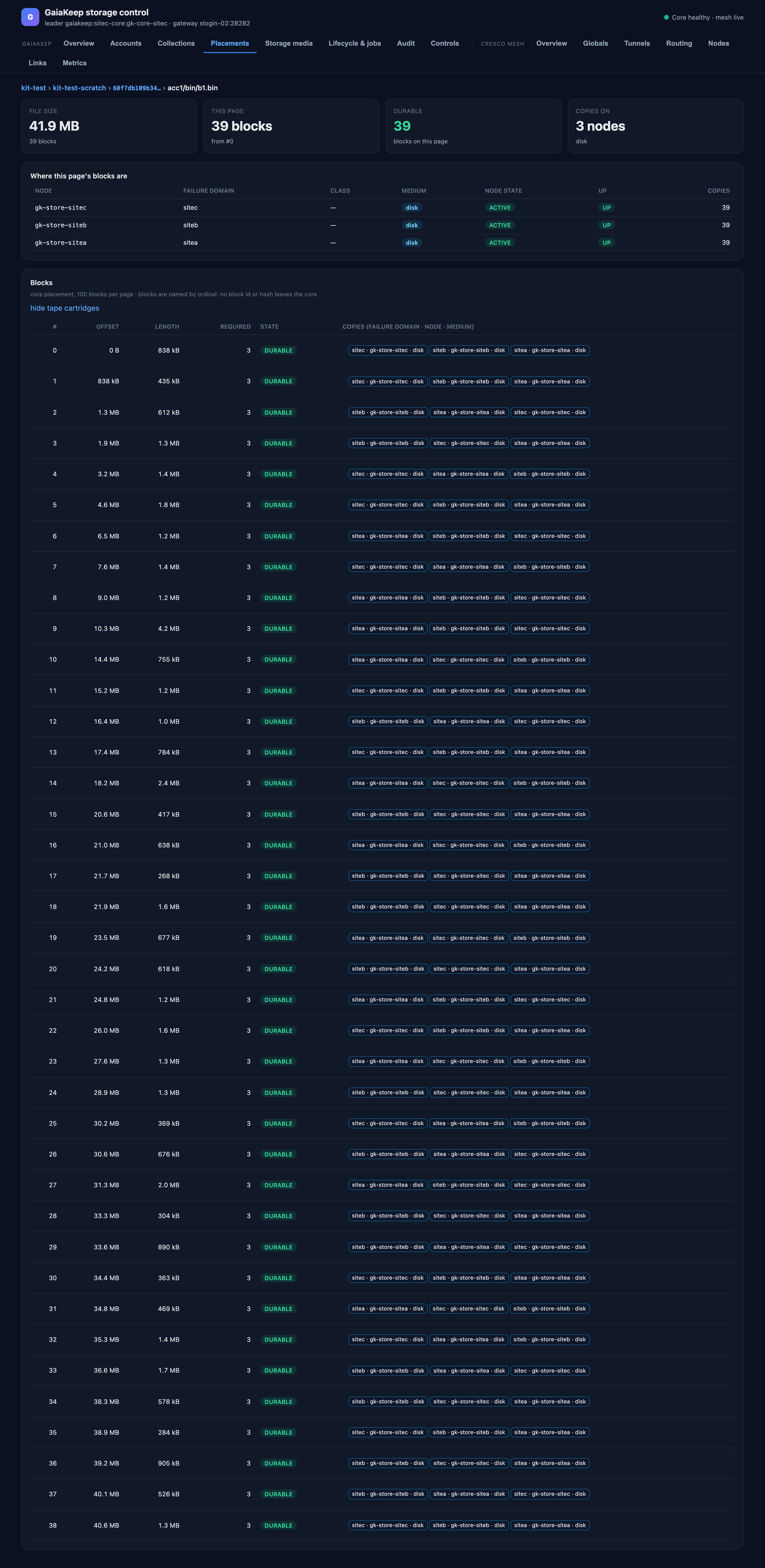
locate tape copies adds one batched locate per archive site to the page, and each tape copy's chip gains the
cartridge barcode, the presence state (verified — read back and checked, claimed — the drive reported
it, exported, absent) and whether a mount is needed to read it:
What placement does not show (yet)
Where on the cartridge the copy sits (file number and block): the design record's open item S-3. And a whole-version placement summary (copies per site for every block at once) would be a data-proportional job — open item S-8.