Lifecycle & jobs
Retention policy, the proposals that change what is forgotten, and every job the core runs — the governance view.
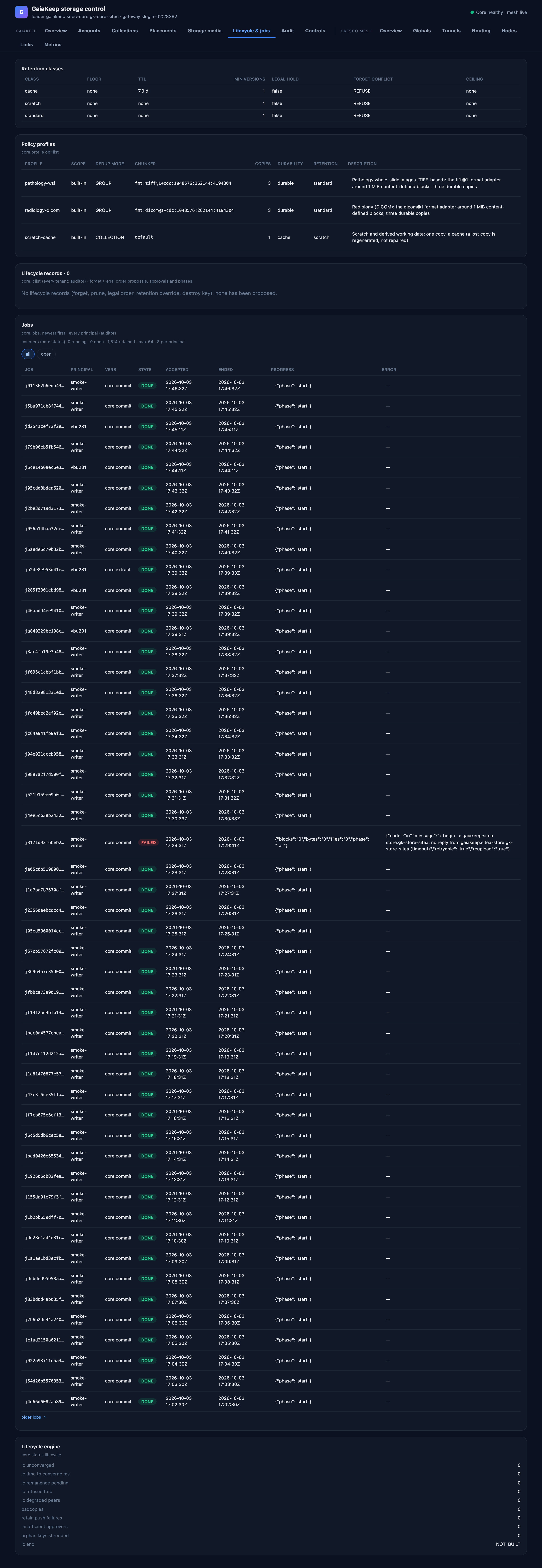
Retention classes
Every retention class the core knows, built-in and defined (core.retention op=list; on an older core the page
falls back to reading the built-in classes one by one):
| Column | Meaning |
|---|---|
| Class | The name collections hold (standard, cache, scratch, …). |
| Floor | The minimum age before anything in the class may be forgotten. |
| TTL | Time-to-live after last write (none for keep-forever classes). |
| Min versions | Versions of a collection in this class that are always kept. |
| Legal hold | Whether a legal hold pins everything in the class. |
| Forget conflict | What a forget does when a version is still referenced (REFUSE). |
| Ceiling | The maximum age after which a copy must not be kept. |
Policy profiles
The named policy profiles — built-in, system-wide, and the tenant's own (core.profile op=list): scope, dedup
mode, chunker, copies, durability, retention, and a description. A collection created under a profile inherits all
of it.
Lifecycle records
Forget, prune, legal order, retention override and key-destruction proposals, with their phases
(core.lclist, paged and scan-budgeted; the auditor reads every tenant's, a tenant-admin their own):
| Column | Meaning |
|---|---|
| Record | The lifecycle id (opens the full record: core.lcstatus). |
| Kind | What is proposed: forget, prune, legal order, retention override, destroy key. |
| Phase | Where it is: proposed → approved → running → done (or refused/cancelled). |
| Tenant / Requester / Created | Who and where. |
| Approvals | How many persons have approved. Approvals must be distinct people, bound by another person, older than the configured minimum age — the core enforces this; the dashboard shows it. |
An empty list means none has been proposed — the expected state of a healthy deployment.
Jobs
Long-running work the core executes (repacks, repairs, archives, verifies), newest first
(core.jobs; any principal sees its own, the auditor sees everyone's — the page names which scope it read):
| Column | Meaning |
|---|---|
| Job / Principal / Verb | The job id, who started it, and the verb behind it. |
| State | Running, done, cancelled, failed. |
| Accepted / Ended | Timestamps. |
| Progress | The job's own progress report (for example files and bytes done). |
| Error | The failure message, if the job failed. |
The counters line above the list (running, open, retained, max, per principal) comes from core.status. Cancelling
a job is a control, not a dashboard feature (Controls).
Lifecycle engine
The engine's own counters from core.status: proposals by phase, approvals, and the guarantees the engine is
holding (cuts, pins, holds).