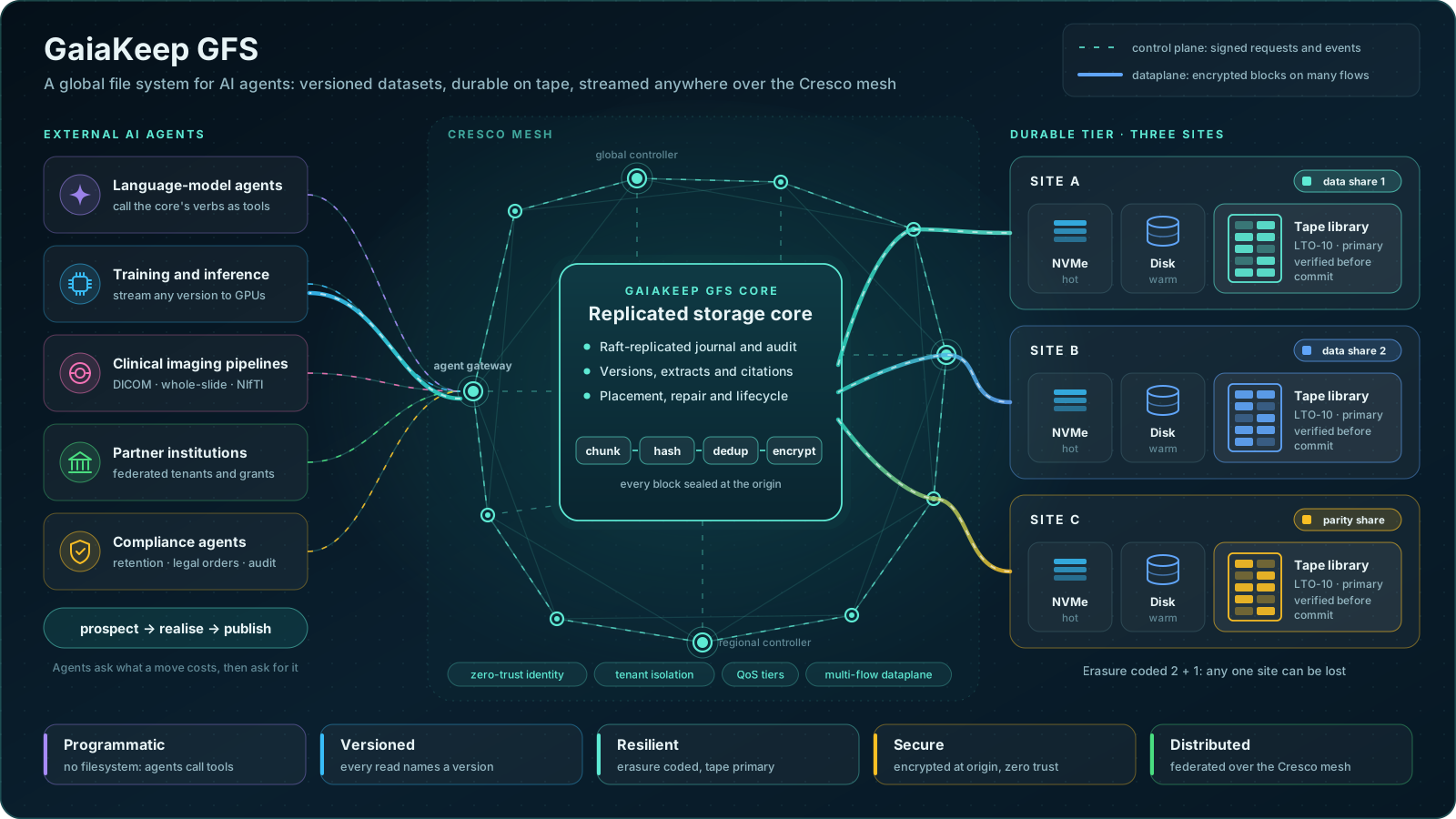
 The target architecture. Erasure coding, tape as the counted primary tier and the caching tier are still being built: see Status at a glance for what runs today.
GaiaKeep GFS
A global file system built for agents, not people. Its job is to keep versioned datasets durable and to stream any version wherever it is needed: to a GPU node, a partner site, or an agent's working cache. Data is stored as raw blocks on memory, NVMe, spinning disk or tape. The medium does not change how callers use it.
"The entire point of this system is to be ready to stream versioned datasets wherever they need to go. This once again is not for humans, it is for agents and to be used by agents."
The system is required to be five things:
| What it means here | |
|---|---|
| Programmatic | No filesystem and no human interface. Agents ask what something would cost, then ask for it. |
| Versioned | Every read names a version. Versions and point-in-time extracts are citable and reproducible. |
| Resilient | Copies in independent failure domains; loss is detected and repaired without intervention. |
| Secure | Encrypted at the origin; storage sites hold only ciphertext; policies scale from full isolation to global sharing. |
| Distributed | Runs over the Cresco mesh across institutions and sites. |
Where things stand
Release 1.3 shipped on 2026-10-01. The durable storage core is built, tested and validated on the HPC cluster. See Release 1.3, Test results and Benchmarks.
- What is proven.
- The 1.3 core: 2,188 automated tests, green in CI. The secured live fabric check passes 88/88 on the HPC cluster.
- Ingest: 8–16 GB at three copies runs at about 150 MB/s and reads back at about 290 MB/s, with no request over 20 s.
- Transport: 0.7 GB/s per flow and over 2 GB/s across 4–8 flows.
- Format-aware dedup: a de-identified DICOM re-upload sends under 1 % of its bytes.
- The prototype before it: 99/99 functional checks, a 240-site federation and a million-file index. See The prototype and Scale results.
- What is built and tested on simulated hardware. The tape software path, on a simulator and on virtual drives. Pack containers on storage nodes. See Status at a glance.
- What you can see running. A read-only storage control dashboard serves against the standing deployment, with screenshots and an exhaustive guide to everything it shows: The storage control dashboard.
- What is still to be decided and built. Raw tape I/O on a real drive. Faster reads over links of 80 ms and more. Erasure coding. The caching tier. See Remaining work and Open questions.
Every status claim on this site uses one of five labels:
| Label | Meaning |
|---|---|
| Proven | Built, and verified by executed tests or campaigns whose results are recorded. |
| Built | Implemented and unit-tested, but not yet on the live path or not yet run end to end. |
| Designed | Specified in the design record; not built. |
| Proposed | A mechanism has been proposed and is waiting on an owner decision. |
| Open | Not yet decided. |
Reading order
- Purpose and principles: what the system is for and the rules that follow.
- Architecture: the layers and how a request moves through them.
- Status at a glance: one table of everything, with its label.
- Remaining work: the phased plan.
Source
- Code, harnesses and the full design record:
GaiaKeep/gfs(private repository; the design record is mirrored here) (private, branch1.3; moved from CrescoEdge on 2026-09-23). - This site:
GaiaKeep/docs.