Accounts
Who the dashboard is, who the principals are, and who the tenants are — from core.whoami per profile (every
10 min) and core.principals (every 60 s).
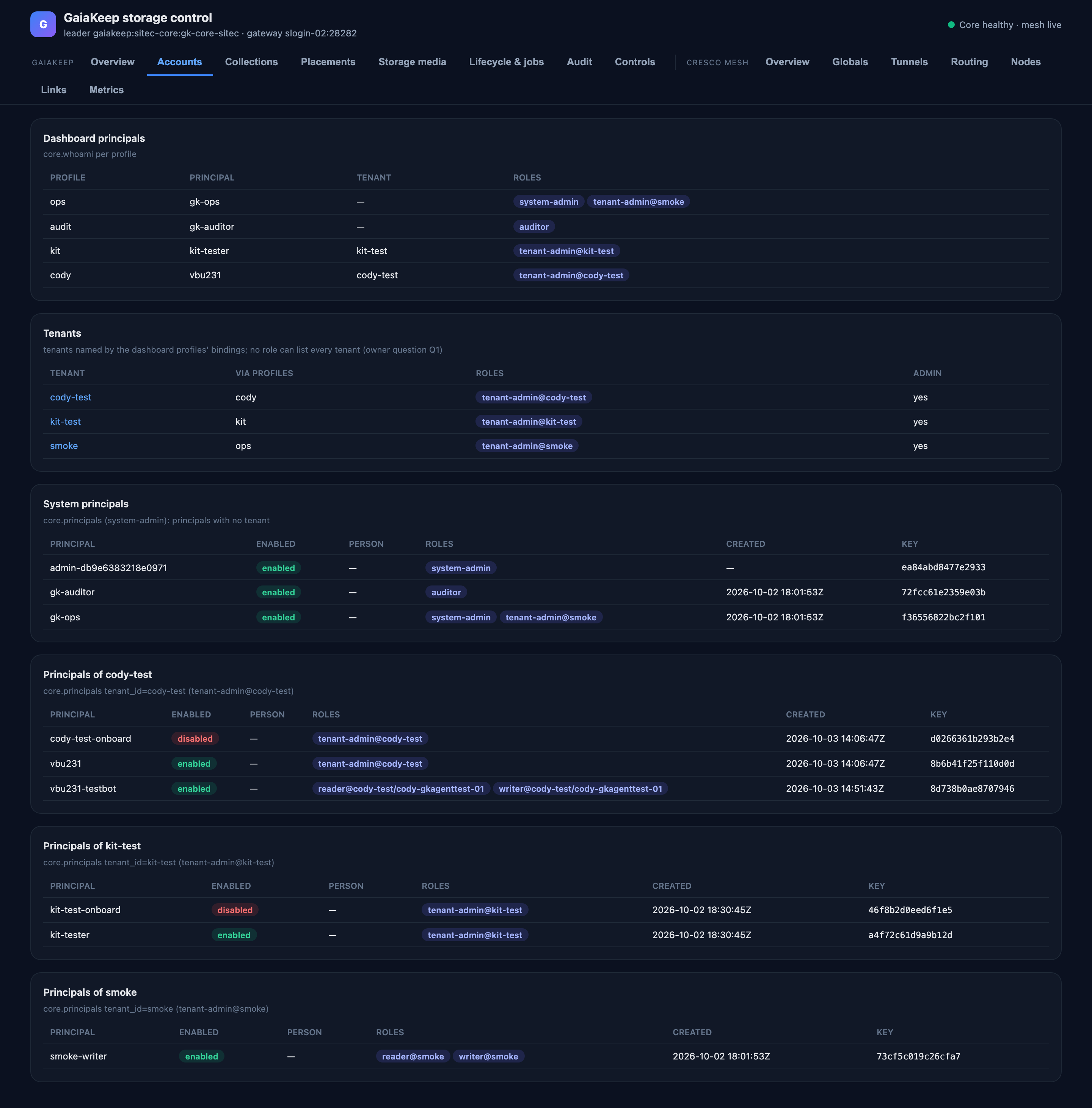
Dashboard principals
One row per configured profile:
| Column | Meaning |
|---|---|
| Profile | The name the server was started with (--gk-profile). |
| Principal | The principal id the core answers core.whoami with. |
| Tenant | The profile's home tenant, if it has one. |
| Roles | The bindings the core lists — system-admin, auditor, tenant-admin@t, reader@t[/c], writer@t[/c]. |
The bindings decide everything the dashboard can show: a datum is read with the first profile whose role the verb's rule accepts, and a tenant appears on this page only because some profile is bound inside it. The page's note says so: tenants named by the dashboard profiles' bindings; no role can list every tenant — whether an operator role should be able to list every tenant is an open owner question (the design record's Q1).
Tenants
The tenants at least one profile is bound in, via which profiles and roles, and whether the dashboard holds a
tenant-admin binding there (Admin: yes). Each tenant name links to its Collections page.
System principals
Principals with no tenant — the core's own service identities and operator accounts: principal id, whether
enabled, the owning person, roles, when created, and the key fingerprint (checked out of band when admitting
something). Read as system-admin. Roles the principal holds outside a tenant are folded into a +N outside count.
Principals of a tenant
The same columns for one tenant's principals, read as that tenant's admin (core.principals tenant_id=t): who the
people are, what they may do inside the tenant, when their keys were created and what fingerprint they carry. A
paged list — more rows continue on the next page.
What this page cannot show
Principals of a tenant the dashboard holds no binding in (the design record's Q5 asks whether system-admin, who can create and disable any principal, should also be able to list every tenant's). Today: no role can, so no page does.